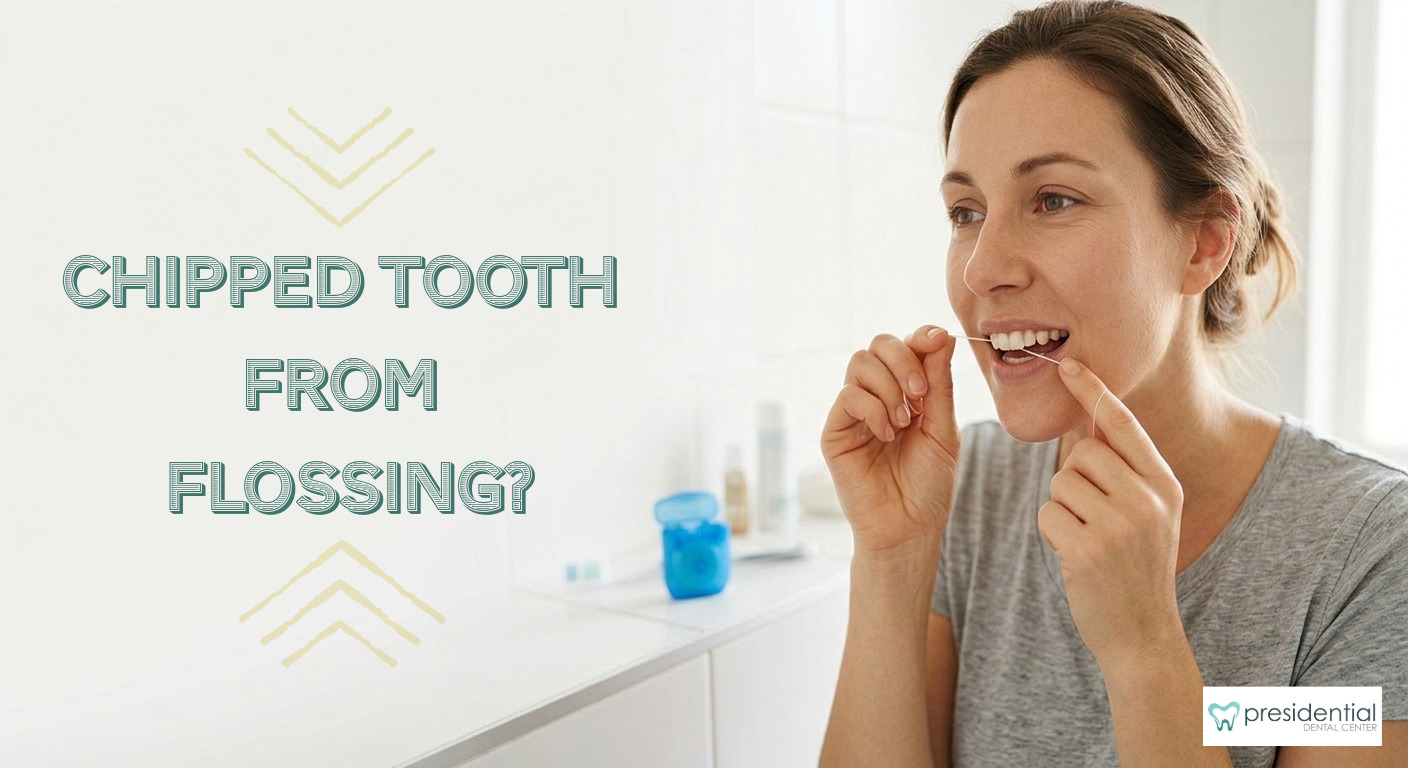
Chipped Tooth From Flossing? Here’s What It Really Means
Flossing didn’t chip your tooth — it revealed that something was already wrong. If you’re dealing with a chipped tooth from flossing in West Palm Beach or anywhere else, that tooth had a structural problem long before the floss got involved. A healthy tooth with solid enamel simply doesn’t break from floss. So the real question is: why was that tooth already compromised?
At Presidential Dental Center, Dr. Melisande Wolff sees this more often than you’d think. The good news? If you act quickly, your options are better — and almost always less expensive.
Why Did My Tooth Chip From Flossing?
There are several reasons a tooth can break from something as gentle as dental floss. Here are the most common culprits.
An Untreated Cavity
If that tooth doesn’t have a filling, the most likely cause is a cavity that’s been quietly hollowing out the tooth from the inside. In this case, a simple filling may be all you need. However, the longer you wait, the deeper that decay can go.
Clenching or Grinding at Night
Many people grind or clench their teeth during sleep without knowing it. Over time, that constant pressure wears away tooth structure, making teeth far more vulnerable to breaking — sometimes from something as gentle as floss.
An Old Filling With Bacterial Leakage
If that tooth already has a filling, the margin where the filling meets the natural tooth can open slightly over time. Bacteria sneak underneath. The filling looks fine from the outside while decay quietly hollows out the structure beneath it. Your floss didn’t cause the break — it simply pulled out a piece that was already failing. That same thing could have happened biting into a tuna salad sandwich.
If it was a white composite filling, what landed on your tongue may actually have been a piece of the filling itself, not your natural tooth.
A Cracked Tooth From an Unbalanced Bite
When your bite isn’t properly balanced — a condition called malocclusion — certain teeth absorb repeated stress over time. That stress creates hairline cracks in the enamel that gradually deepen into the dentin. Eventually, a piece breaks off. This one is particularly sneaky because it builds slowly and often produces no pain until real damage is done.
No Pain Doesn’t Mean No Problem?
No pain right now is genuinely great news. But it doesn’t mean you’re in the clear. Pain level tells us how deep the crack currently goes — and that matters a lot for your treatment options.
- Crack only into the dentin → little to no pain, very treatable (read more)
- Crack reaching the nerve → significant pain, may need a root canal and crown to save the tooth (read more)
- Crack extending down the root → pain when chewing, and sometimes the tooth cannot be saved at all (read more)
Right now, you’re most likely in the first category. As a result, your options are still excellent. But cracks don’t heal on their own — and they don’t stay small forever.
What You Should Do Next?
See your dentist as soon as possible — not because it hurts, but because catching this now gives you the most options and almost certainly the least expensive fix. Waiting until it hurts means the crack has progressed, and your treatment just got more complicated and more costly.
In fact, the fact that you floss every night is genuinely great. This time, your floss did you a favor — it showed you something that needed attention before it became a real emergency.
If you’re in the West Palm Beach area, Dr. Melisande Wolff and the team at Presidential Dental Center are here to help.
Call us at 561.686.8580 or click here to schedule your appointment. Don’t wait on this one.
Dr. Melisande J. Wolff
Frequently Asked Questions
Can flossing actually chip or break a tooth?
A healthy tooth with solid enamel will not break from dental floss. If a piece of your tooth came off while flossing, that tooth was already structurally compromised — the floss simply revealed a problem that was quietly developing underneath the surface. Think of it as your floss doing you a favor.
Why was a tooth already weak in the first place?
The most common culprits are: an untreated cavity hollowing out the tooth from the inside; nighttime grinding or clenching (bruxism) that wears away enamel over time; bacterial leakage under an old filling that silently decays the supporting tooth structure; or hairline cracks from an unbalanced bite (malocclusion) that gradually deepen until a piece breaks off.
What if it doen's hurt, do I still need to see a dentist?
Yes — and in fact, no pain is actually good news that you should act on quickly. It likely means the crack hasn’t yet reached the nerve, which puts you in the most treatable category. But cracks don’t heal on their own, and they don’t stay small. Waiting until it hurts almost always means more extensive — and more expensive — treatment.
What landed on my tongue, was it a piece of tooth or a filling?
It could be either. If the tooth already had a white composite filling, what came off may have been the filling material itself rather than natural tooth structure. In both cases, the outcome is the same: the tooth needs professional evaluation to determine what’s missing, how deep the damage goes, and what the best repair option is.
What are my treatment options?
Treatment depends on how deep the crack or decay goes. If it’s limited to the dentin (the layer beneath enamel), a filling or bonding is often all that’s needed. If the crack has reached the nerve, a root canal followed by a crown may be necessary to save the tooth. In rare cases where the crack extends down the root, the tooth may not be salvageable. The earlier you come in, the more options you have.
Should I stop flossing while I wait for my appointment?
You can be gentle around that specific tooth while you wait, but do not stop flossing altogether. The fact that you floss regularly is a genuine asset to your oral health — it’s how this problem was caught before it became a full dental emergency. Continue caring for your other teeth as normal.
How quickly do I need to be seen?
As soon as possible — ideally within a few days. Even without pain, exposed dentin is vulnerable to bacteria, temperature sensitivity, and further fracture. The sooner Dr. Wolff can evaluate the tooth, the simpler and less costly your treatment is likely to be. If you’re in the West Palm Beach area, call 561.686.8580 to schedule.